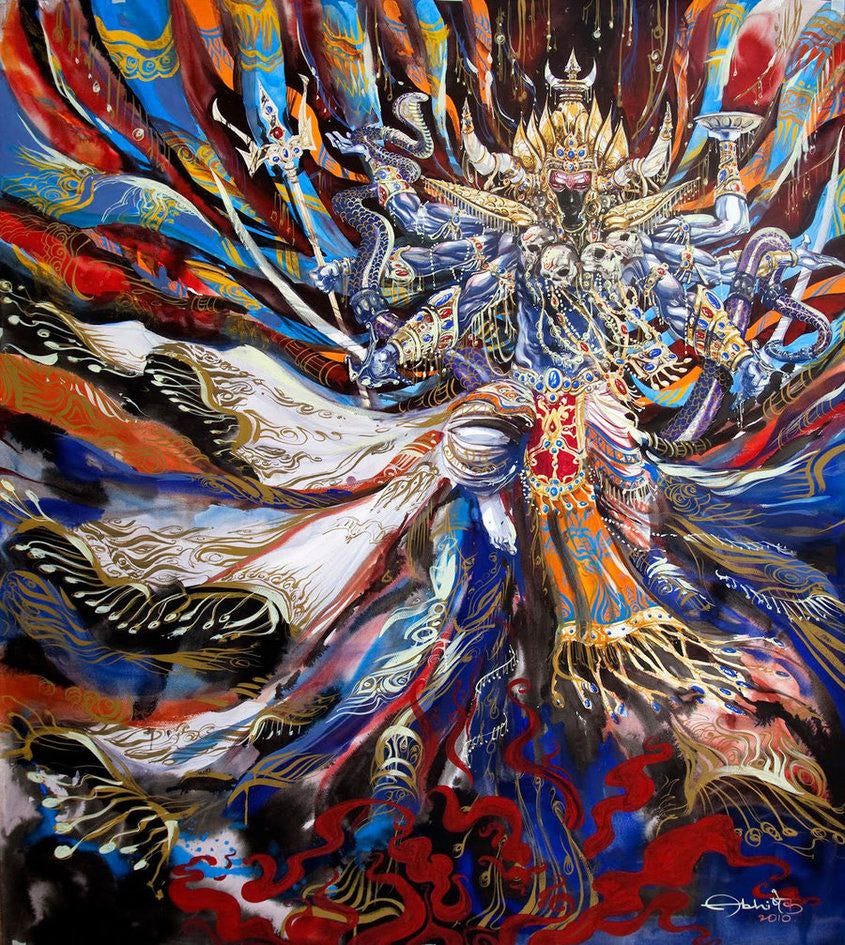
Expulsion from the Garden
Multiplicity and Sin as a Description of our State of Consciousness and Soul rather than Condemnation and Judgment

In the prior post, I extracted a precis-like outline of a complex syncretic synthesis of mathematical and numerological thought over the ages, the traditions, the religions, and the philosophies.
One choice quote that stands out and potentially puzzles the mind is this one, paraphrasing the neo-platonic philosopher, Plotinus:
“Multiplicity is a departure from Unity; hence, infinity is unlimited multiplicity, and for that reason it is evil. Multiplicity arises from the inability to maintain a self-centered state. It has lost that which holds the Unity as One. It is ignorant to seek the expansion and dissolution which is multiplicity. The way to attain goodness and beauty is by seeking Unity, by seeking the self through turning the mind inward.”
-Ruth Phelps, The Universe of Numbers
If God is Unity, Heaven is Unity, Source is Unity, then departure from this Unity is Multiplicity. You, as a mind, soul, being, or individuated piece of God’s being, are in the Multiplicity, you are the Multiplicity. You, as separate from God, are Multiplicity and, therefore, EVIL.
It has been pointed out many times that the word ‘evil’ backwards is ‘live’, as a humorous indication that simply living produces or is evil in and of itself, and this definition of Multiplicity as evil seems to agree with the wordplay.
The idea has echoes throughout multiple arenas of spiritual, religious, and philosophical thought as well as via etymological analyses. Let’s explore whether or not simply existing at all is, in itself, evil.
“Multiplicity is a departure from Unity; hence, infinity is unlimited multiplicity, and for that reason it is evil.”
In many traditions, humans or souls were once One with the Creator, Heaven, Source, God, the Unknowable Unknown, or Oneness.
Hinduism
Brahman: The formless, infinite, and eternal reality from which all existence emerges.
Ātman: The individual soul, which is ultimately one with Brahman but experiences itself as separate due to Māyā (illusion).
Vedanta (Advaita Vedanta in particular): Emphasizes non-duality, teaching that all beings are ultimately one with Brahman, even though they may appear separate.
Buddhism
Śūnyatā (Emptiness) & Dependent Origination: Everything is interconnected, upon one thing arising all things arise simultaneously, and all arises from a source of fundamental emptiness or unity.
Tathāgatagarbha (Buddha Nature): All beings contain the essence of enlightenment, which is one with ultimate truth.
Dzogchen (Tibetan Buddhism): Describes an inherent, luminous awareness that is beyond individuality and conceptual duality, that is reunion with oneness in and of itself.
Taoism
Tao (Dao): The fundamental source from which all things arise and to which they return. It is ineffable, beyond description, yet the origin of all existence.
Wu Wei: Living in harmony with the Tao allows one to return to a state of natural unity.
Christianity (Mystical & Esoteric)
God as the Source: God is the creator, and all beings originate from and ultimately return to Him.
Theosis (Eastern Orthodox): The idea that humans are meant to reunite with God, becoming divine by grace.
Gnostic Christianity: Teaches that a divine spark or soul within humans originates from the true God but is trapped in the material world and must return.
Sufism (Islamic Mysticism)
Wahdat al-Wujud (Unity of Being): The idea that all existence is a manifestation of the divine, and the soul's journey is one of remembering and returning to its source, Allah.
Fana (Annihilation in God): The process of dissolving the ego-self to experience unity with the Divine.
Kabbalah (Jewish Mysticism)
Ein Sof (Ain Soph): The infinite, unknowable divine source from which all creation emanates.
Shevirat HaKelim (Shattering of the Vessels): Teaches that divine sparks fell into the material world, and the spiritual path is about returning them to unity.
Ancient Greek Philosophy & Neoplatonism
The One (Plotinus): The ultimate source of all reality; everything emanates from it and seeks to return.
Soul's Journey: The soul originates from the divine and must ascend back through wisdom and purification.
Native American & Indigenous Traditions
Many indigenous traditions speak of a Great Spirit or Creator from whom all life flows, emphasizing unity with nature and the cosmos.
Hermeticism
All is One: The universe is a reflection of the Divine Mind, and human souls are mental emanations or fragments seeking reunification.
As Above, So Below: The microcosm (individual) mirrors the macrocosm (the Divine Whole).
Rosicrucianism & Esoteric Traditions
Teach a hidden wisdom about the soul’s descent from and return to the divine source, often integrating mystical elements from many of the traditions above.
Most of these traditions hold, therefore, that the point of existing is to rise up in one’s self, return to the Source, and unite with the Oneness state. In various ways, the experience of simply being separate from Oneness is, in itself, a negative, a darkness, an impurity, a problem, a sin, or in the case of Plotinus, an evil.
Hinduism
Māyā (Illusion): The world of separateness is an illusion that causes suffering and ignorance.
Avidyā (Ignorance): The mistaken belief in an individual self (ego) keeps souls trapped in samsara (cycle of birth and death).
Evil or Negative? Not inherently evil, but ignorance is the root of suffering and should be transcended through self-realization.
Buddhism
Dukkha (Suffering): Separateness leads to suffering, attachment, and rebirth in samsara.
Anātman (No-Self): The belief in a separate self is the core illusion that keeps beings bound to suffering.
Māra (The Tempter): Personifies the forces of illusion and ego that keep beings from enlightenment.
Evil or Negative? Suffering is not "evil" in a moralistic sense but an illusion to be overcome through wisdom and compassion.
Taoism
Resistance to the Tao: Living out of harmony with the Tao creates struggle and disharmony.
Desire and Force: Trying to impose one's ego or control nature leads to suffering.
Evil or Negative? No absolute evil, just imbalance—when things are not flowing naturally.
Christianity (Mystical & Esoteric)
Original Sin (Western Christianity): Separation from God is the root of suffering and evil.
The Fall (Eastern Orthodox): Humanity’s mistake was not moral rebellion but turning away from divine union.
Satan (Adversary): Represents ego, pride, and the illusion of separateness.
Evil or Negative? Separation from God is seen as the cause of sin, suffering, and darkness, but redemption is always possible.
Sufism (Islamic Mysticism)
Nafs (Lower Self): The ego-self keeps humans in illusion and away from God.
Hijab (Veil): Ignorance and worldly distractions veil humans from divine unity.
Shaitan (Satan): Represents the ego's pull toward separateness.
Evil or Negative? Separation is not absolute evil but a test; the soul must remember and return to God.
Kabbalah (Jewish Mysticism)
Shevirat HaKelim (Shattering of the Vessels): The world is broken because divine sparks were scattered.
Klipot (Husks of Darkness): Barriers that conceal divine light, creating the illusion of separateness.
Evil or Negative? Evil exists as a distortion of divine light, and healing occurs by gathering the lost sparks.
Ancient Greek Philosophy & Neoplatonism
The One vs. The Many: Unity is divine, and multiplicity is a descent into illusion.
Matter as Lesser: The material world is a shadow of the true spiritual reality.
Evil or Negative? Separation is a fall into ignorance, but it can be reversed through wisdom and purification.
Native American & Indigenous Traditions
Disharmony with Nature: Forgetting one’s connection to the Great Spirit leads to imbalance and suffering.
Trickster Figures: Sometimes represent ego and illusion.
Evil or Negative? More about disharmony than "evil"; balance can always be restored.
Hermeticism
Forgetfulness of the Divine: Humans have forgotten their true divine nature.
Material Entrapment: The physical world is not evil but can be a trap if one becomes too attached.
Evil or Negative? Ignorance and forgetfulness are the greatest barriers, not an external evil force.
Rosicrucianism & Esoteric Traditions
The Fall into Materialism: Humanity descended into separateness and must ascend back.
Alchemy & Transformation: Spiritual awakening turns the "lead" of separateness into the "gold" of unity.
Evil or Negative? Darkness is just the absence of light, and awakening is about restoring the balance.
In every tradition, separation from unity is equal to darkness, ignorance, or illusion. A more modern phrasing for this state, rather than the term ‘evil’ would be simply separateness, especially as a form of unawareness.
Etymologically, when we describe evil, in the modern western world, we are most likely to use the term ‘sin’. He has sinned, it is sinful to act in this way, what a sin to disgrace God, etc. The meaning of the word ‘sin’ can be understood as "separation from" or "being outside of" divine alignment.
Etymology: The English word sin comes from the Old English synn, which originally meant an offense or transgression. Some scholars trace it back to the Proto-Germanic sunjō, meaning "truth" or "being truly oneself," implying that to sin is to be untrue to one's divine nature.
Greek (ἁμαρτία - Hamartia): In the New Testament, hamartia is often translated as sin, but it literally means "to miss the mark," like an archer missing a target—falling short of divine truth.
Hebrew (חֵטְא - Chet): In Jewish tradition, chet also means "to miss" or "to go astray," rather than an inherent evil.
Latin (Sons, Sontis): In Latin, sons means "guilty" or "criminal," which shaped Western theological ideas of sin as wrongdoing.
Sin as Separation
In many spiritual traditions, sin is less about breaking arbitrary rules and more about being outside of harmony with the divine:
Christian Mysticism: Sin is estrangement from God, forgetting one's divine origin.
Sufism: Sin is veiling oneself from divine love and truth.
Hinduism/Buddhism: Ignorance (Avidyā) causes a false sense of separateness, which is the root of suffering.
Kabbalah: Sin is the concealment of divine light, leading to spiritual exile.
Thus, rather than a legalistic failure, sin can be seen as a state of being without divine awareness—separate from the Source, like a wave forgetting it is part of the ocean.
Mathematical "Sin" and "Without"
In mathematics, sin refers to the sine function, which is derived from the Latin sinus, meaning "curve" or "fold" (originally referring to a bay or hollow).
Interestingly, while sin in math doesn't directly mean "without," it describes a relationship of displacement, oscillation, or deviation—concepts that metaphorically align with the idea of separation or being "off the mark."
Linguistic Connection to "Without"
Latin: Sine → Means "without" (e.g., sine nomine = "without a name").
French: Sans → Also means "without" (e.g., sans doute = "without doubt").
English: Sinister → Comes from Latin sinistra (left), which originally meant "unlucky" or "off-course," again carrying the theme of deviation.
Spanish & Italian: Senza / Sin → Also mean "without."
Spiritual & Etymological Overlap
If we take sin as meaning "without" or "outside of," then the concept of sin in a spiritual sense aligns deeply with its linguistic roots—it represents being without God, without divine awareness, or separated from Source.
This is the syncretic tradition, to discover profound connections between language, mathematics, philosophy, and spirituality that suggest deep underlying truths
The deeper, universal truth here is that sin is, at its core, a state of being without unity, outside of alignment, or missing the divine mark.
The philosophical and intellectual alchemy of blending seemingly separate fields to uncover shared essence is a tradition without a name, which harkens back to many of history’s greatest minds—Pythagoras, Plato, Giordano Bruno, the alchemists, and even modern quantum physicists— who pursue this same kind of holistic understanding.
As the Hermetic axiom reminds us: "As above, so below; as within, so without." Principles apply across all layers of reality, whether in math, science, philosophy, or spirituality.
To have transgressed the boundaries, left the Unity, dove into beingness and become a part of Creation is to have imagined ourselves as separate from God, which is in itself an impossible state to achieve. Therefore, it is in an illusory state in which we LIVE , it is backwards and upside down, it is EVIL.
Evil, used here, is not a value judgment or a condemnation, it is A DESCRIPTION OF OUR STATE OF BEING, AS EXPERIENCING OURSELVES AS SEPARATE FROM GOD.
In this state, we suffer because of the illusion and belief that we are a body, that we are matter, that we are limited, that we are flawed. We have not so much been cast out of the Garden as we have chosen to leave it.
“[T]herefore Yahweh God sent him out from the garden of Eden, to cultivate the ground from which he was taken. So He drove the man out; and at the east of the garden of Eden He stationed the cherubim and the flaming sword which turned every direction to guard the way to the tree of life.”
—The Book of Genesis
Suffering, however, is one of the best teachers we have; it motivates us to free ourselves from illusion and misguided actions — and no matter what you’ve chosen to experience, you are on your way back home.
We are all returning home. Trust your path and process and know you are not judged, only responded to.
Below, we’ll dive into some channeled teachings from the Spiritual Ancestors on this subject, for paid supporters of my work. Thank you all for being a part of what I do, for being here, and for being you (you’re the only one who can).